
How to Read Poetry
A poetry skeptic’s close reading of W.B. Yeats and his dad’s email poems.

Poetry has long confounded me. Even though I have devoted so much of my life to the Word, it nevertheless eluded me in its highest, purest form. I preferred the straightforward logic of prose to the elegant whipsaw of poetry. But despite my relentless slandering of poetry, which seems to pluck this word and that, sometimes to great sonic effect and often to no effect at all. And despite my strong feeling that its obtuseness is an indicator of either pretension or laziness, and when asked what something means a poet can shrug and get away with it. Despite all of that mounting incrimination, poetry was where I made my clumsy first attempts at writing and where my father made his final expressions.
My early career as a bard surged back into focus when I was rummaging around in my Mom’s basement sifting through my Dad’s meager archives, in search of what else I could bring home with me. Sadly, my mental catalogue of these artifacts was fairly comprehensive so there were no breakthrough discoveries. No discoveries at all really. But there were reminders. And unless you’re a scientist, reminders are often more meaningful than discoveries. Reminders of how to be. Reminders of how you once were. Reminders of what the world could be.
On the carpet floor of the basement, I was reminded, as I have been more and more since my father’s passing, of our similarities. I had mistakenly pulled down a box of my own belongings thinking they were his, and was struck by the fact that the contents basically mirrored all that was left of him.
Inside were paperback books, a pocket-sized notebook of tortured poems with “WRITE!” penciled on its grey cloth, letters of correspondence between high school friends and my dad while I was away for college, and a small wooden chest I made in 7th grade wood shop class inside of which were my most valuable baseball cards.
My Dad’s truncated archive is much the same — books, notebooks, correspondence of his own, including one letter to Terry where he alternates between sports and political commentary while reflecting on his weeks of fatherhood; baseball, basketball, and football cards; autographs on index cards he requested by mail with return envelopes tucked in; countless pocket schedules (subject of a future essay, preferably for Sports Illustrated).
But whereas every page of my notebook was marked up, my Dad’s loose leaf yellow legal pads were mostly barren. I took a whole stack of these home with me. I reached for one that I thought was untouched, but then I noticed the faintest imprint of handwriting. I looked closer, held it to the light. It could’ve been either of our handwriting. We both wrote in a leaning half cursive, his cleaner and about 70% cursive, mine hurried and closer to 30% cursive. I tried gently shading it with the graphite of a pencil hoping to make a discovery of some kind, but apparently that only works in the movies. That or my father didn’t press his pen deeply enough to make a strong impression.
The most complete writing I have of my father are his many emails, several of which included poems. Following a brief career in sports journalism and a kite of abandoned book ideas, my dad committed himself to poetry. He called these lyrical emails “Goodie Grams,” and sent them to a distinguished coterie of five readers, spanning the Heartland, the Northeast Corridor, the Sonoran Desert, and Paris. I cry whenever I reread them, not for what was said but because in most instances I said nothing at all in response.
I feel fortunate now to have a few friends to discuss writing with, and several to discuss books with, but for many long years, especially early on, I was alone in my devotion to the Word. They are lonely endeavors, reading and writing, but what animates the Word is always an Other. To truly exist, the written word must be read and the spoken word must be heard. The way my father read — crosslegged, his soft back hunched over the book he held balanced in his left palm — reminded me of prayer. Sometimes he whispered the words aloud, breathing them into life.
It felt imperative that I should try reading poetry in earnest. Doing so could bring me closer to my father, whose brevity, deep feeling, and absence of rationality echo in the form I find so inscrutable. Learning to read poetry meant learning patience. It also meant reading differently. The only way poetry had ever made any sense to me was when it was read aloud. I would need to breathe life into these words.
I’d been nursing the germ of this essay idea when I purchased William Butler Yeats’ collected poems in a handsome vintage hardback featuring his brooding face. His eyes are hidden in shadowed sockets under hooded eyes, but his downward gaze and pursed lips carry a resolute melancholy. This photo, combined with a misremembered line from a book that referred to Yeats as the ultimate poet, convinced me to buy the book.
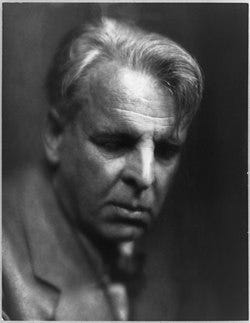
(The line I misremembered was from Hyperion, a bestselling scifi thriller, in which a group of seven strangers are tasked with a last gasp mission to save all of humanity. Together, they voyage to confront the Shrike, a mysterious, murderous creature who exists outside time and dwells in the Time Tombs on the titular planet, which is also home to the City of Poets. One of these strangers is a poet himself, a foul-mouthed wine-drunk alcoholic who confesses the Shrike became his muse at the height of its murderous spree, a spree so bloody it eventually spurred everyone to evacuate the planet. It was this drunken bard, by far the most annoying of the seven characters, who referred to Yeats as the ultimate poet, or so I thought. Only in revisiting the text upon writing this did I realize I mistook Yeats for Keats, as in John Keats, the Romantic poet who died at 25.)
I’m glad it was Yeats in the end because the first poem in this collection filled my sails and the second poem made me tremble.
The first Yeats poem in the collection is “The Song of the Happy Shepherd,” which is hard to cipher, let alone summarize, but I think it’s ultimately about writing. Why write, and to what end? Is it to seek truth or beauty? To record history? To learn about the world?
The poem begins:
The woods of Arcady are dead,
And over is their antique joy;
Of old the world on dreaming fed;
Grey Truth is now her painted toy;
Yet still she turns her restless head:
But O, sick children of the world,
Of all the many changing things
In dreary dancing past us whirled,
To the cracked tune that Chronos sings,
Words alone are certain good.
Upon first reading, I am immediately transported to Acadia National Park, 40 miles from where my father was born in Bangor, Maine, and where a tree was planted in his honor and how he, like a lighthouse, tended a flame of joy despite all the crosswinds he faced in life. I ran my second marathon around Acadia right around this time two years ago. The leaves went supernova, transforming the wood into a breath-taking blaze of mustard yellow, mandarin orange, and red velvet. Their fallen brethren, like the husks of threshed stars, retained their radiance and quilted the earth in embers. I ran 26.2 miles under these arboreal fireworks that swished underfoot like worn parchment, and afterward my father gave me a $100 gift card to a hotel in Bar Harbor. This gift would have been far more useful prior to the trip, but such was the way of my father: he paid attention, he meant well, but he rarely got it right.
On my tenth reading, I’d argue that Yeats is making a commentary on the state of literature. Of old the world on dreaming fed is an indictment of Romanticism, whose dreamy visions idealized the world, stripping it of its rough edges and holding it up to golden sunlight. Grey Truth is now her painted toy indicates a turn toward a more neutral, impartial vision of the world, in part ushered in by scientific methods and advances. But the diminutive painted toy downplays this turn to realism as yet another trend that will pass, which is further reinforced by the seventh line Of all the many changing things.
Describing the toy as painted suggests that the flowery vision held by the Romantics still lingers in some ways. Indeed, it would seem to have a grip on this very poem and on Yeats himself, whose early writings were lyrical and influenced by Percy Shelly, a major figure among the Romantic poets and a contemporary of my mistaken John Keats.
But what endures through all these trends, remaining as constant as Chronos’ crude tune, is the fact that Words alone are certain good. Yeats ascribes an intrinsic value to the Word. It need not be a means to anything else. The Word is good in and of itself. This line appears again in the second stanza and is the only line that repeats in the poem, underscoring its importance.
Go gather by the humming sea
Some twisted, echo-harbouring shell,
And to its lips thy story tell,
And they thy comforters will be,
Rewording in melodious guile
Thy fretful words a little while,
Till they shall singing fade in ruth
And die a pearly brotherhood;
For words alone are certain good:
Sing, then, for this is also sooth.
First, let’s just appreciate twisted, echo-harbouring shell and die a pearly brotherhood. So good! Remember this shell because it will take on a more important role in the second poem, “The Sad Shepherd.”
Now, maybe I’m projecting, but I think this speaks to the writer’s predicament. Writing is a solitary practice, but writers are also incredibly dependent on an Other. We write to be read and to be heard. But finding an audience is hard to come by, and I think 99% of writers probably feel deprived of the audience they deserve. I certainly do. I often labor for weeks or months on an essay, writing several drafts, scrutinizing every word and every transition, only to have it reach 150 readers, sometimes more if my Mom posts it on her facebook.
While it feels good to rack up clicks, and I do obsessively check the metrics after publication, that is not why I write. I write to be understood as I am and to better understand the world as it is. 1% of what I write gets published, the other 99% is for me and my shell. Writing soothes me in a way nothing else can.
That’s what I think this poem is ultimately about: how writing soothes. Yeats never says it outright. He says Seek, Sing, and Dream all sooth. But for me, and I suspect for him as well, seeking and singing and dreaming are all subsumed by the Word.
In the third and final stanza, the narrator announces himself:
I must be gone: there is a grave
Where daffodil and lily wave
From out of nowhere, the narrator declares himself, but his departure is as sudden as his appearance. I can’t help but assign this voice to my father. These words breathed life into him, just as words alone are certain good breathed meaning into me. In that same breath, I think: This is good for the story. But as any writer knows, what is good for a story is usually bad in every other way. An unfortunate fact, an alarming statistic, a bloody detail, a disturbing trend, or tragic twist — all of these are good for a story. A good story is built on pain and often designed to inflict it.
What felt bad in this instance, though, wasn’t so much a pang of grief, but the perverse delight in abstracting the pain. Aestheticizing my anguish was starting to feel like an anaesthetic, but I didn’t know what else to do with it. If I was going to bruise, I would bruise beautifully.
The second poem, “The Sad Shepherd,” was an actual gut punch that left me breathless, not from pain but excitement.

I read the poem with my ears muffed by noise cancelling headphones. I often wore these headphones when reading or writing and almost never played music. I preferred the gentle static issued by the noise cancelling feature, which sounded like the ocean shushing the world. Entombed in this wordless hollow, I could better concentrate on the words before me or within me. I used these headphones like a literary stethoscope — what was it my heart wanted to say today?
But never had I read aloud while wearing these headphones. With my ears muffed, the words amplified as if my skull were an auditorium. I felt the words more deeply, and also felt like I understood language at a subatomic level. Language had a physical component and that physics consisted of vibrations. Words were merely vibrations echoing up my throat and escaping through my teeth. My tongue was a tuning fork, helping calibrate me to the frequencies of my beating heart, which thumped harder and harder with every line announced.
Of course this is only the case with spoken words. If you, like me, withhold your many thoughts, feelings, and observations, then it could be said that words are what lightning into existence inside the storm of consciousness. If you, like me, prefer to write than to speak, words are lassoed and herded into order on a mountain crossing with winter as a deadline. I could run this river dry but let us return to the poem at hand.
There was a man whom Sorrow named his friend,
And he, of his high comrade, Sorrow dreaming,
Went walking with slow steps along the gleaming
And humming sands, where windy surges wend:
And he called loudly to the stars to bend
From their pale thrones and comfort him, but they
Among themselves laugh on and sing alway:
And then the man whom Sorrow named his friend
Cried out, Dim sea, hear my most piteous story!
The sea swept on and cried her old cry still,
Rolling along in dreams from hill to hill.
Once more I think of my father, this time as Sorrow’s friend. Once more I am wowed by Yeats’ description of stars’ pale thrones.
This poem echoes the first, in theme and imagery. We do not know why this shepherd is sad but his sadness is no doubt deepened by the fact that no one is willing to listen to his “most piteous story.” Not the ocean. Not the stars. Not even us, the reader, can say we’ve heard his story. He finds no audience in the world, save for the shell he picks up on the shore.
The shell returns as a hero. It holds real power, and is capable not only of retaining and reflecting the sad shepherd’s words, but also of relieving his ancient burden. But what brought me to a standstill was the sad shepherd’s internal monologue, which made me realize that the sad shepherd wasn’t my father but me.
I will my heavy story tell
Till my own words, re-echoing, shall send
Their sadness through a hollow, pearly heart
And my own tale again for me shall sing,
And my own whispering words be comforting,
And lo! my ancient burden may depart.
I strongly identified with the ache in his voice, and his determination to tell his story over and over again until he is absolved of any burden.
The heavy story I’ve been telling and retelling for the past 19 months has been my father’s death and how our complicated relationship left me feeling guilty for all the resentment I carried for so long. I have written essay after essay trying to explain and absolve myself of this burdensome guilt anchored in some Oedipal desire to exceed one’s parents.
It is completely unoriginal, this feeling of guilt, but it was also completely unexpressed. I didn’t know what to do with the unsaid mountain aching inside me other than to sculpt it into a story hoping that someday I would arrive at a kernel of truth or peace that would act as my pearly heart. I will continue to tell this heavy story until I am satisfied, because the word is good and the word soothes.
I read this monologue over and over and heard my words echo back, amplified by my headphones, which were still transmitting the oceanic hush and were, I realized, no different than the shepherd’s shell.
The shell listens when nothing else will, but it is an artificial ear that operates more like a mirror than a listener. An object that reflects the subject back unto itself, creating a feedback loop vulnerable to distortion, which is precisely what happens: But the sad dweller by the sea-ways long / Changed all he sang to inarticulate moan.
That artifice, in some ways, extends to me as well. While I’ve ostensibly been writing about my dad, it’s mostly been about me. It’s right there in the poem, too: my own words, my own tale, my own whispering. All this aestheticization of my father runs the risk of eclipsing the man himself and who he was to me. To what extent am I rewriting our history to comfort myself? Or worse, to tell a good story?
So let us revisit the man himself on what would’ve been his 70th birthday. Let us read his words and read them closely. I have selected two poems for analysis. When you read them, please join me in reading them aloud so that we can all breathe life into his spirit.
A Gathering of Gray Hair

They sit in a circle,
Seven of them in all,
Visiting a friend in the hospital.
They’ve known each other for
40 years, give or take,
And soon the stories and laughter flow.
Fishing stories, too. (The Walleye
Were biting in South Dakota).
Out of such moments, a life is made.
This poem is about togetherness told from a warm distance. From the very beginning, the narrator is separated from the scene: They sit in a circle, They’ve known each other. I can also say with some certainty that my dad had no fishing stories, as he’d never been fishing. He wasn’t much of an outdoorsman and he didn’t know how to swim.
Although the narrator is not an active participant in this particular gathering, he nevertheless participates in their retrospection. The eight of them are all old heads looking back on life, telling and retelling the same old stories. Reliving the good old days is always helpful kindling, especially among old friends with whom you no longer possess the intimacy you once held but that you wish to recover. Or when visiting a friend in the hospital when you both would rather be anywhere but there. So you retread familiar territory, traffic in the same old stories, until the words and feelings flow freely again.
But unspoken in the background of this buoyant, life-affirming poem is the specter of death. The hospital patient is not just old, but presumably receiving end-of-life care. I could be wrong, but when else do seven friends visit simultaneously after 40 years of friendship?
It is not resigned to this eventuality though, as was characteristic of my dad whose optimism remained unwavering despite weary facts. The poet’s eye focuses on togetherness, the bonds that hold people together, and the knitted moments that make up a life. In most readings, I thought the moment referenced this gathering of gray hair, but now I read it much more expansively and think it also encompasses the stories we carry with us.
Riding the 54 Bus

I climb on the 54
weary after a long day
It’s crowded and I
grab the first seat I see.
It’s next to a pervert.
Two women get on after me.
The pervert says hi to both of them.
I find myself strangely miffed
he didn’t say hello to me.

I look at him.
He’s not a pervert,
just one of God’s broken creatures.
He’s just friendly.
Then he says hi to me.
I’ve ridden this bus a hundred times.
Usually nothing memorable,
although, sometimes, public sex!
Nothing memorable today though.
But someday, someday I will get on this bus and my life will be changed.
I have always been drawn to public transportation writing, which I like to think of as an urban subgenre of the road novel, which is itself a modern variation of the hero’s journey. But what really interests me about this subgenre is that its subject is democracy itself.
There is something undeniably democratic about boarding the subway and hurtling through the dark underground as a quiet collective with a lottery of individuals from all stations of life. All of your destinations will remain unknown to each other, but in that cramped moment you’ll have exchanged glances, made space for each other, perhaps even aided each other with directions or a steadying hand.
In this poem, the narrator is being cheeky in what is ultimately an exercise in humility. The poem begins humbly enough, boarding a bus after a long day at work. But immediately the narrator pits himself against his fellow passengers in a competitive, comedic animosity — separating himself (It’s crowded and I), outcasting his neighbor as a pervert after seizing a seat, envying the two women that the pervert greets.
The second stanza is a series of humbling reversals that ends profoundly with a killer last line. In a moment of empathy and humility, the pervert becomes one of God’s broken creatures while the narrator expresses his own latent sexual desire.
These inner transformations lose traction, however, in the final lines of the poem when the narrator laments nothing memorable or extraordinary happening on this bus ride. But let’s pause here because I don’t know how trustworthy or reliable the narrator is at this point. He has already undeservingly slandered one of his fellow passengers and then retracted it. And the longing for change in the last line, which is equal parts hopeful and devastatingly sad, makes me wonder if the reversals in character weren’t actually transformative but corrective. Maybe the narrator is issuing a mea culpa, and what he really desires is the forgiveness and grace he extended to the pervert for himself.
Undergirding this spiritual longing for transformation is an attention to the magic that can arise from the everyday. The narrator really believes that something as ordinary and undramatic as a bus ride can be life-changing. That is, in my view, the task of the writer. To pay close attention to the world so that when its magic reveals itself, you are ready. These moments may seem small, they may seem common, they may seem entirely unworthy of attention. But, as a wise poet once said, out of such moments, a life is made.
I’ll end with one final moment that my dad captured in a poem.
A Moment of Grace

If we’re lucky our lives are
a series of moments
of love.

I have been lucky.

Last night my oldest son and
his girlfriend and I
went for ice cream.

It was getting dark
and the parking area was not well lit.

The concrete was rough,
with chunks of concrete
scattered everywhere.

Connor, fearing I would fall,
took my arm and guided me to the stand.

It was a moment of love
and grace, a moment that will stay
with me forever.
I remember this evening vividly. It was summer, the sky was dark, the night air swelled with cicadas. It was his first time meeting Celina and my dad, never one to turn down social company, wanted to keep hanging out, so we went to Zesto’s for ice cream and sat around a picnic table and talked late into the evening.
Thank you, dad, for memorializing this moment. May it live forever.
If you enjoyed this close reading analysis, you might also like my deep dive on Knausgaard’s My Struggle, which was incredibly readable and relatable and served as a kind of nostalgia-machine, dredging up core memories vivid rooted in emotion.
And you will definitely like Devin Kelly’s weekly newsletter in which he unpacks a single poem. I have long admired Kelly’s tender essays on endurance running, pain/injury, and masculinity. I chanced upon his Substack recently and recommend reading his latest — a beautifully written piece that unexpectedly expands into the poetry of togetherness Mamdani campaigned on and really sticks the landing with a brief marathon dispatch.
Connor, your insights, your prose, your honesty in this piece genuinely brought tears to my eyes. I kept stopping, rereading lines, letting them settle. There are so many beautiful turns of phrase, so many moments where you shape language into something that feels like poetry itself.
Passages like this;
“With my ears muffed, the words amplified as if my skull were an auditorium. I felt the words more deeply, and also felt like I understood language at a subatomic level. Language had a physical component and that physics consisted of vibrations. Words were merely vibrations echoing up my throat and escaping through my teeth. My tongue was a tuning fork, helping calibrate me to the frequencies of my beating heart…”
That’s not just writing, that’s a sensory experience. It’s someone showing the reader how language feels in the body, how thought becomes vibration, how emotion travels.
And then the way you write about the unspoken, the thoughts we withhold, the “lightning inside the storm of consciousness,” the way writing becomes its own kind of crossing, its own form of survival, that moved me deeply. It’s such a beautiful reminder of how important it is to understand our own feelings, the feelings of others, and the way we move through the world in relation to them.
Thank you for sharing something so intimate, so thoughtfully constructed, and so deeply reflective. I could run this river dry trying to articulate how much I loved this piece, but I’ll simply say this: it made me think, it made me feel, and it made me grateful, grateful for your voice, for your perspective, and for the way you see and shape the world.
Connor there is something in your father’s poetry that brings to mind Philip Larkin, particularly the ode on the bus journey with the pervert. A joy to read.